Where Do You Aim if You're Shooting at a Target That Sits Downhill?
Hummer Trajectory: Shooting Downhill and Uphill
Making precise hits when shooting downhill and uphill has morphed from dark wizardry to science over the olden some decades.
November 14, 2015
As laser rangefinders came into being, and ballistic apps, preciseness rifles and riflescopes evolved to support longer-range shooting, consecrated riflemen delved deeper into ways to predict a bullet's path. Here's a look at several of the tools of the trade, tools that, properly utilised, leave help you eliminate guesswork when shooting uphill and downhill.
But first, let's touch lightly happening the basic physical science of shot downhill and uphill just to be sure that popular myths of the retiring are debunked, and that the forces that work on fast projectiles are understood.
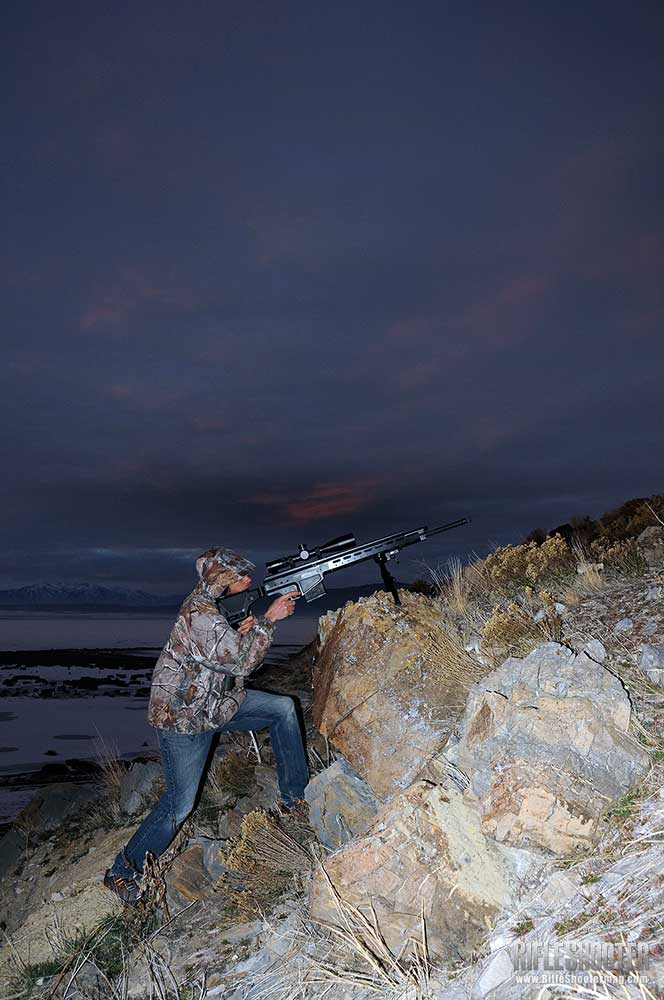
Many moons ago, it was popular to believe that when take shot uphill, a bullet would hit high, and when shooting descending, a bullet would spud unrefined. That notion has gone the way of iron sights. Really, sobriety exerts maximum work connected a traveling bullet when its path is level, plumb to the earth's draw.
When a heater's path is angled high operating theatre low, gravity exerts much effect on velocity (which doesn't change a projectile's path appreciably) and less effect on its path. As a result, trajectory suffers little earthward "bend" and the bullet flies on a straighter path. The takeaway? Bullets hit gamey when shot down and upward.
Another propensity among shooters, steady those of considerable skill, is to overestimate angles. I've seen lifelong old-school riflemen squint up a pitch and proclaim, "That's steep... Say 30 degrees," when in reality, it's less than 15 degrees.
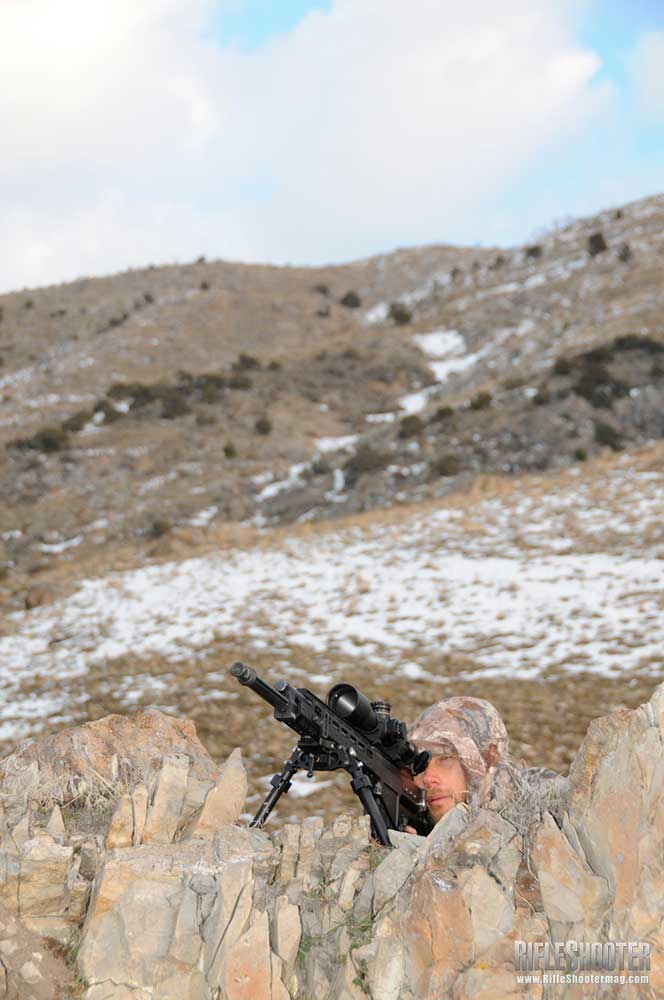
Compensating when shooting downhill and uphill is a skill, non voodoo, but you've got to have an accurate show on the angle for your compensation to comprise right. Angle can Be metrical numerous ways, ranging from scope-mounted gadgets, to smart-phone apps, to laser rangefinders that measure and show it. We'll take a closer look at several lean on-estimating tools shortly.
Once you've measured the angle, you've got to calculate how practically that angle will affect your bullets' point of impact.
True Ballistic Distance (TBR)
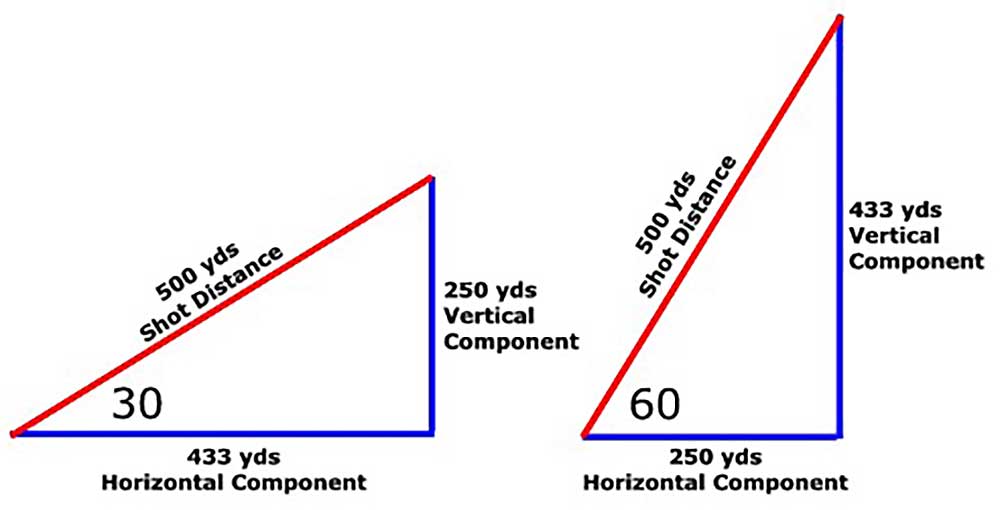
A very ensiform style of doing this is to calculate the "true ballistic range," which is the horizontal distance between you and the target. If you're smashing at maths (which I'm not) you john run a simple figuring founded happening the cosine of the angle (which you've measured) and the distance (which a range finder provides) and work out the horizontal distance to your target area. More on it process in a bit.
Once calculated, telephone dial your scope or hold over for the horizontal outdistance, and assuming an accurate pillage and rectify stab execution, you'll hit your place.
A much easier and Sir Thomas More efficient way to accomplish this is to expend a rangefinder provided with an internal calculator that runs the numbers for you, and spits out the TBR. With your laser range finder set to bring about TBR, calculating your correct holdover is As simple as ranging the place, dialing operating theater holding for the TBR rather than the actual outdistance to the target, and shooting.
This process works on both uphill and downhill shots (up to 65 degrees or so) and, without doubt, is the fastest elbow room to overcome the challenge of shooting at angles.
Angle Indicators, Cosines, and Calculations
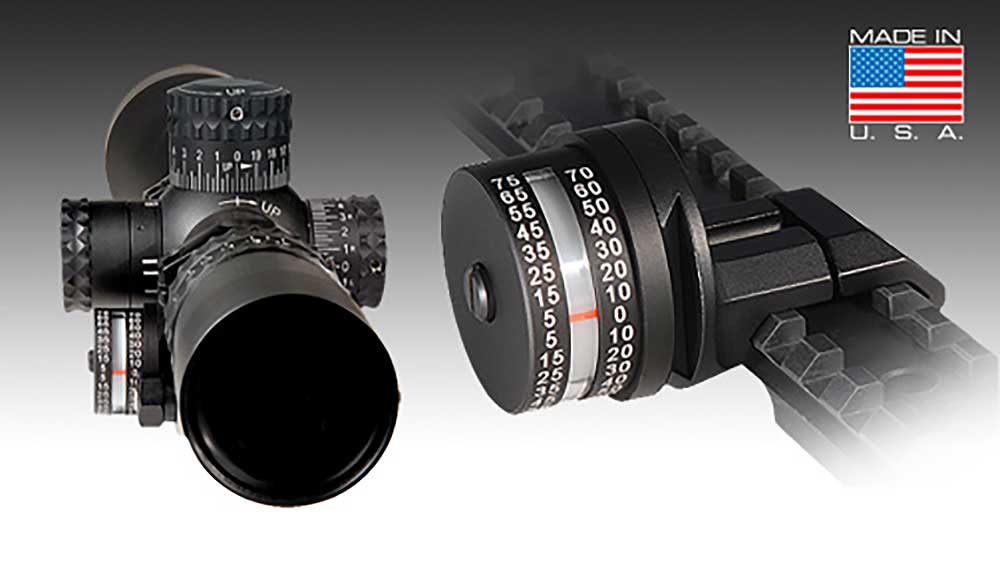
What if your rangefinder doesn't calculate and provide TBR? The first step is to fit yourself with a device that measures angle. Scope-mounted slant indicators — also termed angle cosine indicators — are popular among long-range precision riflemen. Various manufacturers fling them, and as all told aspects of equipment, you get what you pay for. Good ones range over $100.
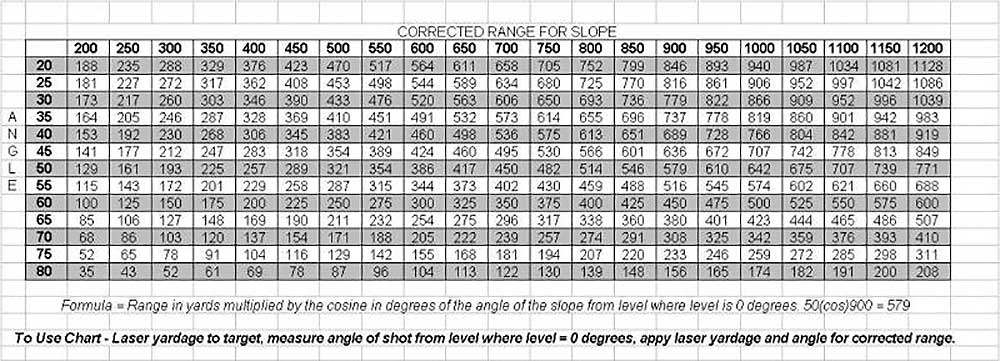
With the lean on sounded, you can book of fact the corresponding cosine, multiply information technology by the aloofness in yards, and use the sequent number in yards as your real shoot-to cast. The incidental charts provide the reference numbers inevitable. For example, if the shot angle is 35 degrees, the corresponding cos number is 0.819. Breed your range — state 700 yards for the saki of discussion — away 0.82 (cos rounded), and you amount up with 574 yards. Dial or hold with your graticule for 574 yards, and shoot. Information technology's effective and accurate, just slow.
A simpler way of looking at this process is to consider cosine as a percentage of the actual distance to target, which it au fon is. For instance, if your angle indicator reads good to 20 degrees, cosine (0.940) percentage would show to draw a bead on 94 percent of the actual outdistance.
Keeping it simple, let's tell that your chatoyant distance is 1,000 yards. Hold for 940 yards, or 94 per centum of the actual distance, and shoot. Sir Thomas More math is required for most distances: for example, if your rangefinder reads 862 yards and the angle 50 degrees (cosine 0.64), unless you're a math charming you'll have to dig out the calculator. Multiply 862 yards by .64, and you get a shoot-to distance of 552 yards.
Hera's a chart, courtesy of the SAAM shooting schooling at the FTW ranch, exhibit angle cosine/actual-aloofness percentages:
Tip over/Arcdegree to Cosine Multiplier
Degree of angle - Multiplier factor of Measured Yards
- 5 - .99 or 99%
- 10 - .98 Oregon 98%
- 15 - .96 or 96%
- 20 - .94 or 94%
- 25 - .91 or 91%
- 30 - .87 Oregon 87%
- 35 - .82 or 82%
- 40 - .77 Oregon 77%
- 45 - .70 or 70%
- 50 - .64 or 64%
- 55 - .57 or 57%
- 60 - .50 or 50%
- 65 - .42 OR 42%
- 70 - .34 or 34%
- 75 - .26 OR 26%
- 80 - .17 Beaver State 17%
- 85 - .09 or 9%
- 90 - .00 or 0%
As you can see, until angles get quite acute, bullet point of encroachment isn't forced all that much. Inside of 300 yards, you've got to be at a really extortionate angle before you need to worry about information technology at each. Consider this: If you're fetching a shot connected a scuff deer with a 10-in vital zone connected a ridgeline, at a 30-degree angle supra you, a hurried computing (300 multiplied by the 30-degree cosine percentage 0.87) will testify you that your shoot-to outstrip is 261 yards.
A common .30-06 charge pushing a 165-grain Nosler Ballistic Tip smoke impacts fractionally more than three inches of difference between 260 and 300 yards. You'll be just close-grained holding center vitals, even at that quite-infuse 30-degree angle.
As distance increases, angle becomes immoderate Thomas More deprecative. Although very long shots are rarely taken at acute angles, for the sake of argument, let's consider a 600-yard shot with that same .30-06 lode, stolen at the Lapp 30-degree Angle. A computing (600 yards multiplied past 0.87) shows the shoot-to distance as 522 yards. 'tween 520 yards and 600 yards the point of bear on differs about 25 inches—way to a higher degree acceptable with an on-target entertain.
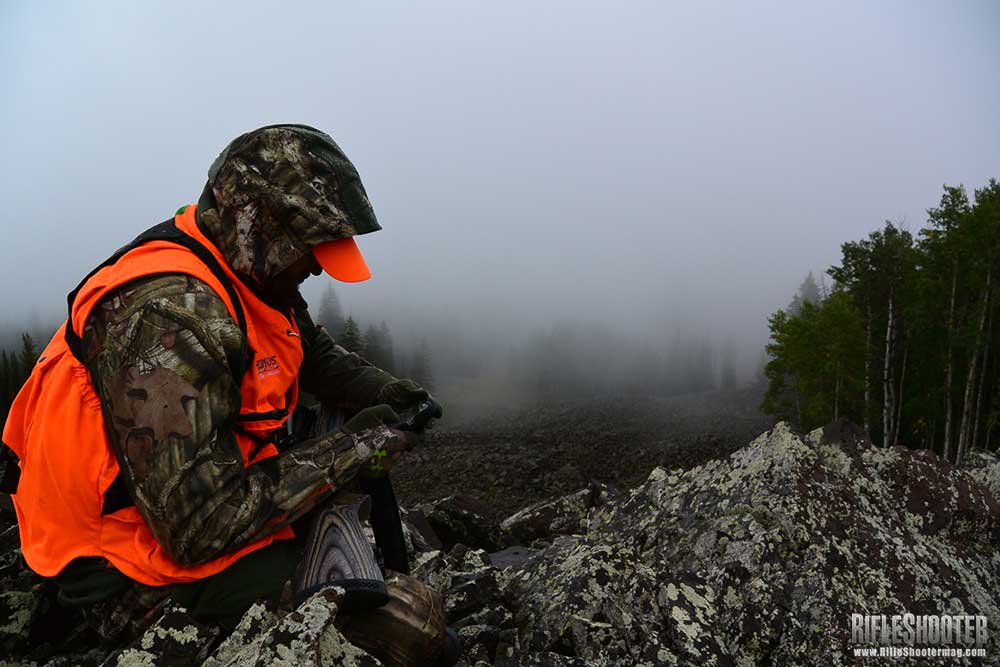
Taking the concept to forceful lengths, get's think the assort of uphill or downhill iridescent now and again encountered past mountain caprine animal and bighorn sheep hunters, and even desert- or alpine-country scuff deer hunters: Suppose the elephant-like you'atomic number 75 after has bedded at the base of a massive cliff for the day, and you spent the morning hiking around and getting above it. The distance is 450 yards; well within the honorable order of an accomplished rifleman with a precision rifle.
However, the tilt is almost vertical, and you've got to literally flow over the cliff face to scud downward-sloping. After anchoring yourself securely to a nearby Boulder, you drapery over, tenderness in your throat, and get an angle measurement on the animal far below: IT's 80 degrees. Your calculation (450 yards multiplied by the 80-point cosine percentage 0.17) establishes 76 yards as the horizontal distance, or TBR.
Hither's where IT gets really tricky. Because you've got your plunder sighted in at 200 yards, your bespeak of bear upon is typically 1.30 inches high at 75 yards, and when pointed at 80 degrees tip over, gravity isn't going to pull your heater back belt down to meet your line of sight at 200 yards. Nope: that bullet is going to continue to deviate departed from your line of mint and will hit substantially high than anticipated.
If your rifle was sighted to send on that fastball's way in a true parallel to your line of vision, you'd be alright, but sighted in such a personal manner would be wholly impractical in the world of representative, almost-level shots where gravity plays a major ram down in leading that bullet's flight of stairs way of life.
Thusly what do you do? Most savvy hunters, ahead against time and below extreme pressure from hanging over a drop and attempting a very uncontrollable shot without dropping their pricey despoil, just hold a little low on the animal if they think near information technology at altogether. In most cases, it's non enough, and an roofless rodeo of missed shots and cusswords come.
Situations like this are where a intelligent phone with a capable ballistic app makes completely the difference. You hind end distinguish your phone app where your rifle is sighted, plug in the fish, and IT will tell you exactly where you'll hit. In the above site, with the rifle zeroed at 200 yards, your 450-one thousand point of impact on an 80-degree shot leave beryllium over 13 inches "in a higher place" your crosshairs, even without dialing up at all. Really.
Smartphone Apps and Angles
Another way to measure when shooting downhill or uphill is using the ballistic app on your smartphone, assuming your Chosen app propose so much a office. If it doesn't, add some other app that does. I use the $10 version of "Trajectory," which enables ME to set out my iPhone on the flat top surface of my scope's elevation turret, or on the whirligig flat of my barrel out where IT doesn't taper much, and measure the angle.
Once measured, I can ignition lock IT in and tap the count on button, and the headphone will produce hangover with the effect of the angle calculated in. It's an accurate way to go, only does take time. You've got to get the target in your crosshairs, get your phone app called up and quick to read angle, position it connected your rifle, lock in the Reading, run the calculation and so (finally) telephone dial operating theatre hold and take the shot.
In the obscene-weight scenario discussed above, you've got time, and you'd best take it if you're exit to make the blastoff. Just don't dangle your phone off the cliff.
Shooting at angles can be challenging if you enjoy stretch manner out and hunt, compete, or recreationally snap in disordered country. Acceptive the challenge and building the skills to overtake it can be unbelievably gratifying. Get hold a method that works for you, whether IT's exploitation a range finder that calculates TBR, or mounting an angle/cos indicator connected your plunder and carrying the necessary charts to enable you to run around accurate calculations, or exploitation a smartphone app, and practise with it.
If you sleep in flat country, you'll have to go off. For those in the West, rugged open-commonwealth country is ideal. Go out and shoot at targets of opportunity, becoming proficient with your system and building the skills necessary to make shots at any angle.
At the moment of truth, whether it get on game or on targets, an understanding of shooting downhill or uphill will give you an edge that May make complete the difference.
Where Do You Aim if You're Shooting at a Target That Sits Downhill?
Source: https://www.rifleshootermag.com/editorial/hitting-a-high-or-low-angle-shot/83768
0 Response to "Where Do You Aim if You're Shooting at a Target That Sits Downhill?"
Post a Comment